
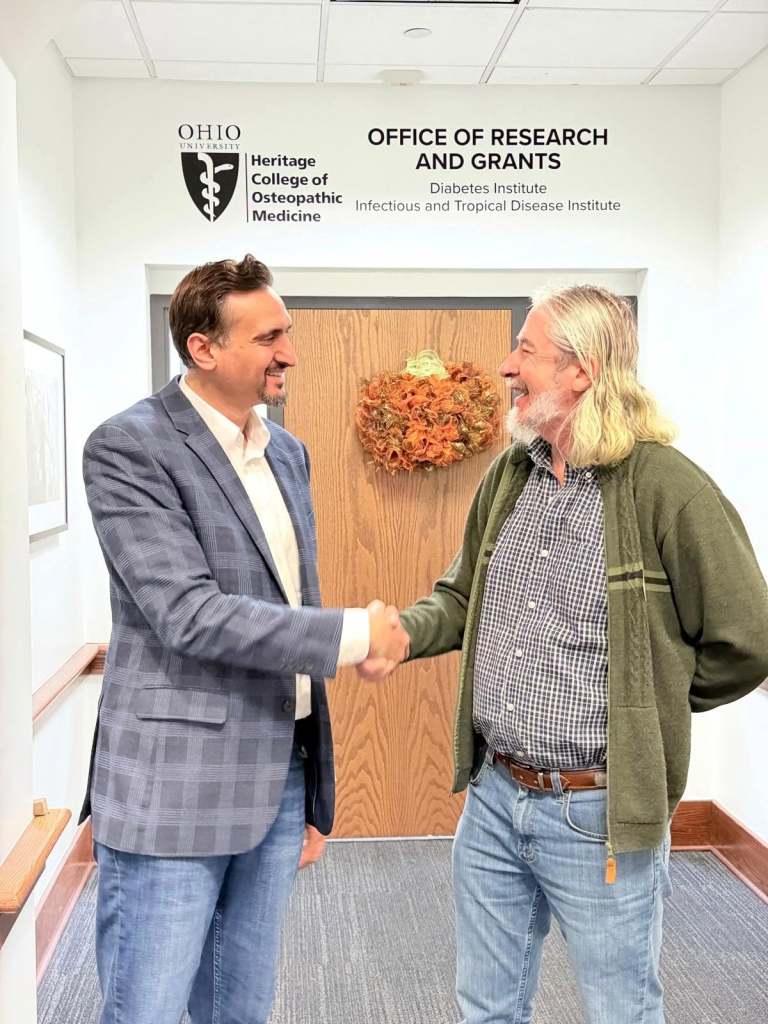
In early 2019, Dr. Mario Grijalva and I started a conversation about a disease most people have never heard of. Mario directs Ohio University’s Infectious and Tropical Disease Institute (ITDI) at the Heritage College of Osteopathic Medicine and is a professor of microbiology. He has spent decades studying Chagas disease in the lab and in the field, much of that work in his native Ecuador. I have been an affiliated faculty member of ITDI since 2018, and my own work focuses on how audiences find, process, and engage with media. Our question was simple: why does a disease that affects millions of people across the Americas barely register in public conversation, and what does the conversation that does exist look like?
Almost eight years later, that question has taken us from YouTube comment sections to motorcycle roads across South America.
“A silent disease that is silenced”
Chagas is caused by a parasite, Trypanosoma cruzi, most often spread by blood-feeding insects known as kissing bugs. The bug bites, defecates next to the bite, and people unknowingly rub the parasite into the wound when they scratch. It can also pass from mother to child during pregnancy, through contaminated food, and through blood transfusions or organ transplants.
What makes Chagas so dangerous is its patience. After a short initial phase that may bring fever or no symptoms at all, the infection can stay quiet for years, even decades, while it slowly damages the heart and digestive system. By the time symptoms appear, much of that damage cannot be reversed. There is no vaccine, but there is treatment, which is why early diagnosis matters so much.
When I asked Mario why the disease stays invisible, his answer stuck with me. An estimated 7.5 million people are infected, and roughly nine out of ten don’t know it because they lack access to diagnosis. Undiagnosed cases never make it into public health statistics, so there is little pressure to invest in diagnostic services, and the cycle repeats. In his words, Chagas is “a silent disease that is silenced.”
Media attention follows a similar logic. A chronic illness that slowly affects poor and rural communities doesn’t fit a news cycle that rewards what is new and dramatic. Mario pointed out that around two billion people live with neglected diseases in the same category: under-covered, under-funded, and commercially unappealing.
Where we started: listening to YouTube
Our first project together asked what public conversation about Chagas actually sounds like online. In The Kiss of Death – Unearthing Conversations Surrounding Chagas Disease on YouTube, published in Cogent Social Sciences, Mario and I, along with Aggrey Otieno, and colleagues, analyzed comments posted under five YouTube news videos about Chagas. Drawing on Uses and Gratifications Theory and the Health Belief Model, and using Netlytic for text analytics and SentiStrength for sentiment, we looked at which comments drew the most engagement, what concerns people raised, how often they talked about susceptibility, severity, prevention benefits, barriers, and self-efficacy, and how positive or negative the overall tone was.
That project reinforced something I see across my research: comment sections are one of the most candid records we have of what ordinary people believe, fear, and misunderstand about health. For a disease that rarely makes the news, that record is especially valuable.
Then Mario got on a motorcycle
During the pandemic, Mario noticed that motorcycle travelers documenting their journeys on YouTube were drawing huge audiences. He saw an opportunity. He pictured a scientist leaving the lab and the comfort of Athens, Ohio, to ride through the parts of Latin America where Chagas is present, telling the story through the people who live with it, treat it, and fight it.
There was one problem. He didn’t ride. So he learned, failing plenty along the way (and, as he admits, still failing sometimes). He taught himself to mount cameras on the bike and helmet, fly drones, and edit. The result is Jaguarundi Moto Adventure, the YouTube home of the Riding Against Chagas project (En Moto Contra el Chagas).
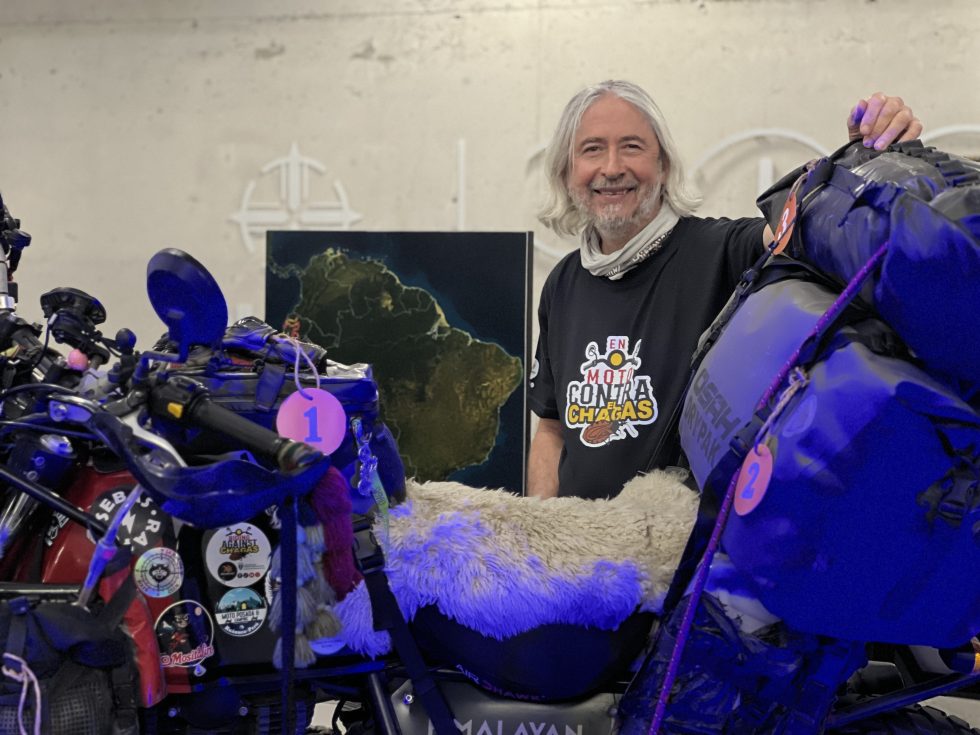
The motorcycle turned out to be a communication tool in its own right. The bike carries the project’s logo, and every stop becomes a point of contact. People ask where he’s from, where he’s headed, and why. Those conversations become one-on-one health messaging on the spot: Have you heard of Chagas? Have you seen these bugs?
The stories he collects are powerful. In one episode filmed in a rural community in Cutervo province, in Peru’s Cajamarca region, a health care worker describes how she had been seeing Chagas every day without recognizing it, until she learned what to look for. In the same episode, a woman explains how her family kept waking up with welts from bites without knowing why, until a biologist searched the house, found the bugs, and the home was sprayed.
Mario has ridden about 18,000 miles so far through Ecuador, Peru, Bolivia, Argentina, and Chile, with Colombia and Brazil ahead and another 10,000 miles planned. At the time of our conversation, he had published about 85 long-form episodes and roughly 500 short pieces across YouTube, Instagram, TikTok, and Facebook, and his YouTube channel had drawn thousands of views.
Our conversation
I sat down with Mario for Research Exchange to talk about the science, the ride, and what he has learned about reaching people online. It’s one of my favorite conversations, and well worth the half hour.
One moment made me laugh and also made me think. Mario has tried many approaches to make his content stand out, but as he put it, “when I put a cat in my video, it has more views.” His most-viewed TikTok, at around 50,000 views, is a playful clip of him stuck at a roadblock, staging a mock race between his motorcycle, a pickup truck, and a dump truck. It ends with a small Riding Against Chagas watermark. Fifty thousand people saw that watermark. That tension between entertainment and substance sits at the center of science communication on social platforms, and it is exactly what we are studying now.
What we’re working on now
Mario and I are now working on a joint study of health messaging in travel vlogging. Travel content is one of the most engaging genres on YouTube, and Mario’s channel offers an unusual case in which the traveler is a working scientist. We want to understand the engagement mechanisms around travel video and how they intersect with health messaging. A few of the questions guiding us:
- What draws viewers to travel video in the first place: landscapes, food, the people met along the way, or the rider’s own personality and setbacks?
- When a health message rides along with an adventure, does the adventure carry the message, or compete with it for attention?
- How does the connection viewers build with a traveler over many episodes shape whether they listen when he talks about disease?
- What role do short clips play in pulling new audiences toward longer, more substantive episodes?
These questions matter well beyond Chagas. Platforms are built to keep people scrolling, and serious health content often loses that contest. If we can understand how storytelling and engagement work together, we can help researchers, health agencies, and creators make neglected issues visible without sacrificing accuracy. As Mario put it, “You need to go where people are.”

Why this partnership works
This collaboration sits where I think more research should: at the meeting point of biomedical science and communication research. Mario brings decades of field knowledge and a willingness to try something few scientists would attempt. Our lab brings tools for understanding audiences at scale. Neither of us could do this work alone.
Mario closed our interview with a line I have thought about many times since: “Finding a voice is important, but giving somebody else a voice is even more important.” That is what Riding Against Chagas does, and it is what good health communication research should do too.
If you haven’t yet, I encourage you to ride along.
Explore further
- Watch Jaguarundi Moto Adventure on YouTube: https://www.youtube.com/channel/UC4EWcyCy63X1kqWg15Rvksw
- Learn about Riding Against Chagas at ITDI: https://www.ohio.edu/medicine/itdi/research/riding-against-chagas
- Mario’s expert profile: https://www.ohio.edu/experts/expert/mario-j-grijalva



Leave a Reply