I am delighted to share that our collaborative study, “When AI Speaks Like Us: The Role of Brand Anthropomorphism in Driving Brand Love and Evangelism Across Developed and Developing Markets,” has been accepted for publication in the Journal of Marketing Theory and Practice (5.2 Impact Factor – 5 year 2025). This work brings together colleagues across three continents to answer a question that matters more every day: when generative AI talks, reasons, and seems to feel like a person, what actually makes people love the brand behind it, and go on to champion it to others?
The question behind the research
Traditional brands earn human-like personality through marketing. Generative AI is different. Tools like ChatGPT, Gemini, Claude, and DeepSeek already write, converse, and respond with apparent emotional sensitivity. The human qualities are not just implied by a logo or a mascot; the system performs them. That raises a real question for theory and practice alike: do the old rules linking “human-like” brands to consumer loyalty still hold when the brand itself simulates thinking, feeling, and moral reasoning?
To find out, we surveyed 531 generative AI users across four countries: two developed (the United States and the United Kingdom) and two developing (Oman and Pakistan). We broke brand anthropomorphism into four distinct dimensions and tested how each one shapes brand love and brand evangelism using PLS-SEM.
The four dimensions were:
- Moral virtue: perceived trustworthiness, fairness, and ethical integrity
- Cognitive experience: perceived intelligence, reasoning, and problem-solving ability
- Appearance: interface design, conversational style, and social presence (reconceived beyond physical looks for non-embodied AI)
- Conscious emotionality: the AI’s apparent capacity for empathy, warmth, and emotional expression
What we found: brains and integrity beat charm
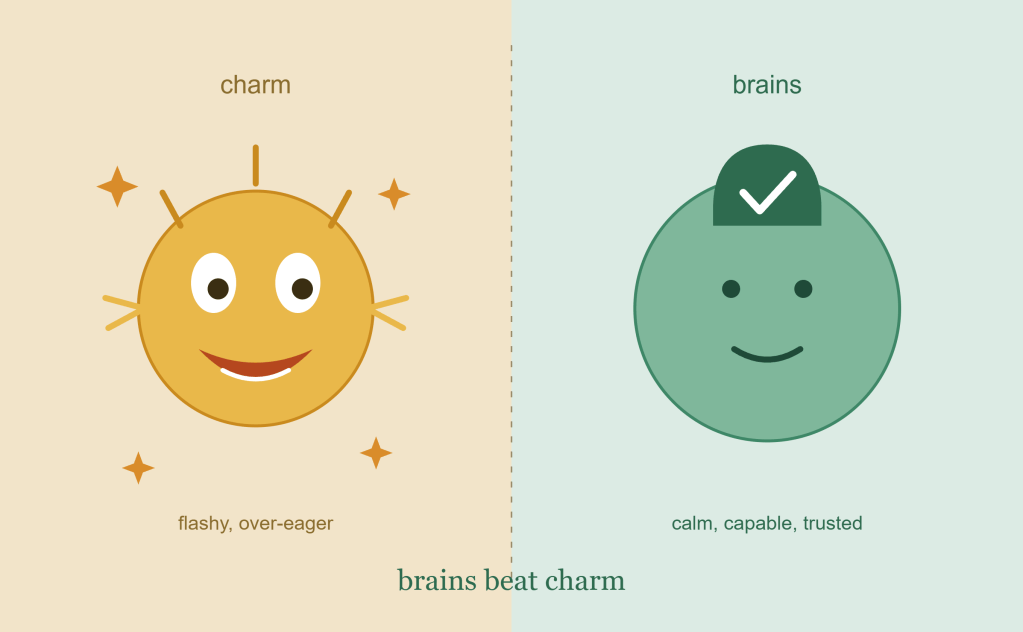
All four dimensions positively influence brand love. But they are not equal. Moral virtue was the strongest driver of brand love, followed by cognitive experience, appearance, and finally conscious emotionality. In plain terms, people fall for AI brands they see as trustworthy and genuinely capable, not the ones putting on a personality.
The most striking result concerns emotion. Conscious emotionality, the AI trying to seem empathetic and feeling, had the weakest pull on brand love and, more surprisingly, a negative effect on purchase intention and on positive word-of-mouth. When an AI performs emotion that reads as forced, artificial, or mismatched to the moment, users pull back. As the practitioner write-up of this work put it, forced emotionality can alienate users rather than endear them. Brains beat charm.
Love is the bridge to advocacy
Here is the mechanism that ties it together. Brand anthropomorphism on its own does not turn people into evangelists. It works by first building brand love, which then converts into advocacy: recommending the brand, sticking with it, and defending it against rivals. In our model, brand love was the psychological bridge. Every anthropomorphic dimension reached evangelism through that bridge, even the dimensions that had little or no direct effect on advocacy. The lesson for marketers is that you cannot shortcut your way to loyal advocates through clever design features. You earn the emotional connection first, and advocacy follows.
One world, two playbooks
Because we compared developed and developing markets, we could see that the path to brand love is not identical everywhere.
In developed markets (US and UK), moral virtue and cognitive experience mattered more. These consumers place heavier weight on whether an AI brand is trustworthy, reliable, and capable of sound reasoning. Their bar for ethical consistency is higher, and brands that clear it earn deeper commitment.
In developing markets (Oman and Pakistan), appearance (the human-like, conversational quality of the interface) played a larger role in brand love, and cognitive experience and moral virtue were especially important for driving purchase intention and referrals. These consumers lean toward immediate, tangible signals of competence and accessibility.
Across both markets, the discomfort with performed emotion held. The negative effect of conscious emotionality on purchase intention and positive referrals was especially notable in developing countries, which we attribute to unease with how current generative AI expresses emotion, often without accounting for cultural and contextual nuance.
What this means for developers and marketers
The takeaways are practical:
- Lead with trust and competence. Build reliability, transparency, and ethical behavior into the core of the product, and make those qualities visible. This is the single strongest lever for brand love.
- Invest in substance over personality. A genuinely intelligent, problem-solving assistant earns loyalty that a charming or overly chatty one cannot.
- Handle emotion with care. Emotional cues should be subtle and supportive, never theatrical. Calibrate them to context, culture, and language, because overdone emotion backfires.
- Localize the strategy. Emphasize trust and ethics in developed markets; emphasize practical intelligence and an intuitive, relatable interface in developing markets.
- Remember the sequence. Anthropomorphic features feed brand love; brand love produces evangelists. Design for the emotional connection, not just the feature.
Why it matters
As billions of people fold generative AI into their work and daily lives, the design choices behind these tools shape not only how useful they are but how much people trust and champion them. Our research offers a roadmap: users are not looking for a pretend friend. They are looking for a partner they can rely on. Build that, and the love and advocacy follow.
This study was led by Dr. Khalid Hussain (Sultan Qaboos University, Oman), with Imran Khan, Dr. Muhammad Junaid (Asian Institute of Technology, Thailand), Dr. Ghanem Elhersh (Stephen F. Austin State University, Texas), and myself at Ohio University’s SMART Lab. I am grateful to this team for a genuinely global collaboration.
Read the practitioner summary of this research in GreenBook: What Users Like/Don’t Like about AI.




Leave a Reply