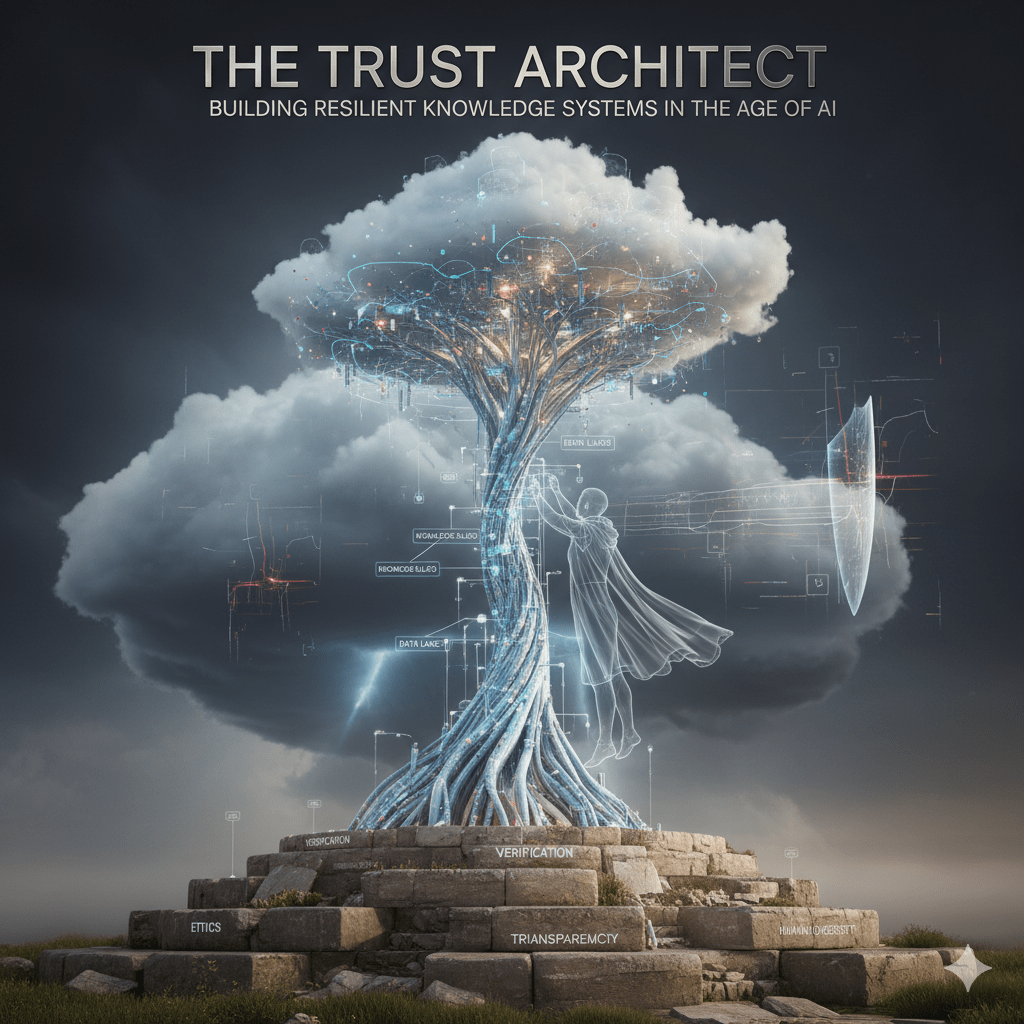
The Trust Architect: Building Epistemic Resilience in an Age of Algorithmic Truth
How do we sustain truth and trust when artificial intelligence shapes every conversation we have?
We live in an era of algorithmic curation. Every scroll, click, and conversation unfolds within invisible architectures of code—systems that decide what information reaches us, which voices amplify, and ultimately, what we come to believe. In this landscape, trust has become paradoxically abundant and scarce: we trust our devices implicitly while doubting nearly everything they show us.
This is the central tension of our moment. As a scholar of communication, I’ve spent years examining how technology mediates human understanding. What I’ve come to realize is that we’re not simply experiencing an information crisis—we’re witnessing the transformation of truth itself. The question isn’t whether we can fact-check our way out of misinformation. It’s whether we can redesign the very infrastructure through which knowledge flows.
The Velocity Problem: When Lies Move Faster Than Light
Consider how information travels today. A false claim about a public figure can circle the globe in hours, accumulating millions of engagements before any correction emerges. By the time fact-checkers publish their findings, the damage is done—not because people are gullible, but because our digital ecosystems reward speed over accuracy.
I call this the velocity problem. Misinformation doesn’t succeed merely because it’s false; it succeeds because it’s engineered for velocity. Our platforms privilege emotion, outrage, and novelty—precisely the qualities that make falsehoods spread. Truth, by contrast, is slow. It requires verification, nuance, context. In an attention economy that measures success in milliseconds, accuracy becomes a competitive disadvantage.
This isn’t an accident of design. It’s the design. Social media platforms optimize for engagement, not enlightenment. Algorithms amplify content that keeps us scrolling, regardless of its veracity. The architecture itself—the recommendation engines, the infinite feeds, the metrics of virality—creates an environment where misinformation thrives.
As scholars and practitioners in communication and the wider information field, we must develop what I call infrastructural literacy: the capacity to understand not just the content of misinformation, but the systems that enable it to flourish. We need to read the architecture, not just the messages it carries.
The AI Mediator: When Machines Join the Conversation
Now add artificial intelligence to this equation. AI has fundamentally altered the nature of communication itself. These systems don’t merely transmit or filter information—they generate it. Large language models write news articles, draft emails, and increasingly, produce the very content we consume and share. Chatbots simulate empathy with uncanny precision. Deepfakes render video evidence unreliable.
This represents a categorical shift in human communication. For millennia, we developed sophisticated heuristics for evaluating trustworthiness: reading facial expressions, detecting vocal inflections, assessing credentials. These mechanisms evolved in a world where communication was fundamentally human. What happens when the voice on the other end of the conversation isn’t human at all?
AI-mediated communication raises profound epistemic questions—questions about how we know what we know. When algorithms curate our information environment, where does human judgment reside? When content is algorithmically generated, how do we distinguish authentic expression from synthetic production? The line between what is said and what is computed has dissolved.
This isn’t simply a technological challenge; it’s a philosophical one. We’re forced to reconsider fundamental assumptions about meaning, intention, and truth. If a machine can generate text indistinguishable from human writing, what does authorship mean? If an algorithm can predict what will persuade us before we know it ourselves, what becomes of autonomy?
These questions aren’t academic abstractions. They shape whether citizens can engage meaningfully in democratic discourse, whether communities can organize effectively for social change, whether individuals can maintain coherent identities in digital spaces.
Building Resilience: The Architecture of Trust
If the velocity problem and AI mediation represent the crisis, what might resilience look like? I propose we need epistemic resilience—not merely the ability to identify individual falsehoods, but the capacity to preserve the conditions that make truth-seeking possible.
This requires us to become what I call trust architects: designers of systems, pedagogies, and institutions that embed verification, transparency, and human accountability at their foundation. Being a trust architect means asking different questions:
- How do we design communication infrastructures that resist manipulation rather than reward it?
- How do we cultivate discernment rather than simply demanding skepticism?
- How do we foreground context over clickbait, depth over virality?
- How do we build platforms that amplify marginalized voices rather than concentrate power?
The answers won’t come from technology alone. They require interdisciplinary collaboration—bringing together computer scientists and ethicists, designers and educators, policymakers and community organizers. We need technical solutions, certainly: better content moderation, transparent algorithms, robust verification systems. But we also need social and educational responses: media literacy programs, ethical frameworks for AI development, institutional mechanisms for accountability.
Paradoxically, AI itself can be part of the solution. When guided by human-centered, value-driven design, these systems can help identify misinformation patterns, reveal algorithmic bias, surface diverse perspectives, and expand civic understanding. Machine learning can detect coordinated disinformation campaigns. Natural language processing can flag manipulated media. Network analysis can reveal hidden influence operations.
But, these capabilities only serve democratic ends when embedded within ethical frameworks that prioritize human dignity, epistemic justice, and collective wellbeing. Technology is never neutral. The question is always: whose values does it encode, and whose interests does it serve?
Trust as Democratic Infrastructure
Here’s what I’ve come to believe: Trust is not merely a feeling between individuals; it’s the infrastructure of democracy itself. Without shared mechanisms for establishing truth, democratic deliberation becomes impossible. Without epistemic common ground, we fragment into parallel realities, each with its own facts, its own expertise, its own conception of the possible.
The erosion of trust we’re witnessing, in institutions, in expertise, in each other, isn’t just a social problem. It’s a crisis of democratic capacity. When citizens can’t agree on basic facts, when every claim is dismissed as propaganda, when expertise is indistinguishable from opinion, collective self-governance fails.
This makes the work of building epistemic resilience fundamentally political. It’s not about creating systems of control or enforcing orthodoxy. It’s about designing conditions where truth-seeking can flourish—where evidence matters, where good-faith disagreement is possible, where collective learning can occur.
The Path Forward: Wisdom Over Intelligence
I want to close with a provocation: We don’t need smarter machines; we need wiser humans.
The future of trust will not emerge from code alone. It will be co-created through critical thinking, ethical design, and epistemic humility. It will require us to ask not just “Can we build this?” but “Should we build this?” and “Who benefits when we do?”
As researchers, educators, and practitioners, we have both opportunity and obligation. We can design better platforms. We can develop pedagogies of digital discernment. We can advocate for policies that prioritize human flourishing over corporate profit. We can build institutions that anchor truth-seeking in an age of algorithmic uncertainty.
This work is urgent. The velocity problem accelerates daily. AI-mediated communication expands hourly. But it’s also deeply hopeful. Because while technology reshapes the landscape of truth, human beings still author its meaning. We remain the architects of trust.
The question is, what we’ll choose to build!
Highlights from my talk delivered at the CommDev Colloquium, September 26, 2024


 Laeeq Khan, Ph.D.
Leave a comment