
In the dynamic world of digital content, a new trend has emerged with significant implications: ChatGPT-related content on YouTube. Our latest journal article is a collaborative research effort between Professors Khalid Hussain, Laeeq Khan, and Aqdas Malik. The study delves into this evolving trend, offering valuable insights for content creators and AI tool developers. After a rigorous blind peer review, the paper was finally published in the prestigious Journal of Digital Business.
With the rise of generative artificial intelligence (AI), particularly ChatGPT, an intriguing academic conversation has unfolded regarding its use across various fields. However, one area that remained unexplored until now was how audiences engage with ChatGPT-related content on YouTube. Our study, therefore, sought to fill this gap by examining the engagement levels such content receives on this popular platform.
The research involved a meticulous analysis of data extracted from 100 YouTube videos focused on ChatGPT, collectively amassing 65 million views. We utilized three application programming interfaces (APIs) for this purpose: VidIQ, Tubebuddy, and SocialBlade. To provide a comparative perspective, we also looked at 200 videos from the same content creators but not related to ChatGPT. Our analysis tools included one-way ANOVA, multigroup Structural Equation Modeling (SEM), and comparative line graphs.
We grounded our study in the Uses and Gratifications (U&G) theoretical framework. This approach helped us understand the motivations behind audience engagement with these videos.
Key Findings
Our findings are revealing in several aspects:
- Increased Engagement with ChatGPT Content: Videos related to ChatGPT garnered significantly higher engagement compared to other content types from the same creators.
- Subscriber Count Less Influential: Interestingly, the ChatGPT-focused content showed less sensitivity to the channel’s subscriber count. Channels with fewer subscribers often saw higher viewership on these videos.
- Boost in New Subscribers: Channels experienced a notable increase in new subscribers when they posted ChatGPT-related content, compared to their other videos.
Implications
The implications of these findings are manifold and extend across various sectors:
- For Content Creators: Understanding the audience’s attraction to ChatGPT-related content can guide the development of more engaging material.
- For AI Tool Developers: Insights into how audiences interact with content about their products can inform future development and marketing strategies.
- For Advertisers and Content Publishers: This study provides valuable data for targeting and content strategy decisions.
This pioneering study not only sheds light on the unique dynamics of audience engagement with ChatGPT-related content on YouTube but also opens the door to further research in this area. It offers critical insights for a wide range of stakeholders, from content creators to AI developers, and highlights the ever-changing landscape of digital content consumption.
The research can be accessed here: https://www.sciencedirect.com/science/article/pii/S2666954423000194
Abstract
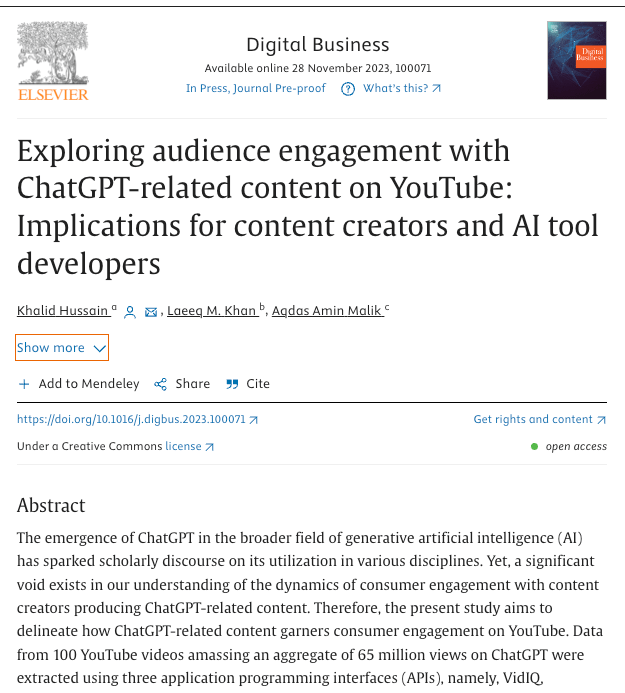
The emergence of ChatGPT in the broader field of generative artificial intelligence (AI) has sparked scholarly discourse on its utilization in various disciplines. Yet, a significant void exists in our understanding of the dynamics of consumer engagement with content creators producing ChatGPT-related content. Therefore, the present study aims to delineate how ChatGPT-related content garners consumer engagement on YouTube. Data from 100 YouTube videos amassing an aggregate of 65 million views on ChatGPT were extracted using three application programming interfaces (APIs), namely, VidIQ, Tubebuddy, and SocialBlade. We subsequently contrasted this dataset with data from 200 other videos produced by the same creators. The data were analyzed using one-way ANOVA, multigroup SEM, and comparative line graphs. Employing the Uses and Gratifications (U&G) theoretical framework, our results indicate that innovative content such as ChatGPT-related videos garners more engagement than other content types from the same YouTube channels. Intriguingly, this study finds that ChatGPT-focused content exhibited diminished sensitivity to channel subscriber counts, with channels having fewer subscribers achieving higher viewership numbers. Furthermore, ChatGPT-related content induced a surge in new subscribers to the channel compared to the other content types. The present study pioneers the investigation of audience engagement with ChatGPT-related content by juxtaposing it with other content from the same YouTube channels. We also explicate the relationship between content sensitivity and extant subscriber counts. The present study provides vital insights and implications for a diverse audience, including content creators, developers of AI tools, advertisers, and content publishers.



 Laeeq Khan, Ph.D.
Leave a comment