
In a world increasingly shaped by algorithms, dashboards, and digital decisions, the role of data analytics in business education is no longer a luxury, it’s a necessity. Business schools across the globe are recognizing this imperative and actively seeking ways to embed data-driven thinking into their curricula, teaching strategies, and institutional planning.
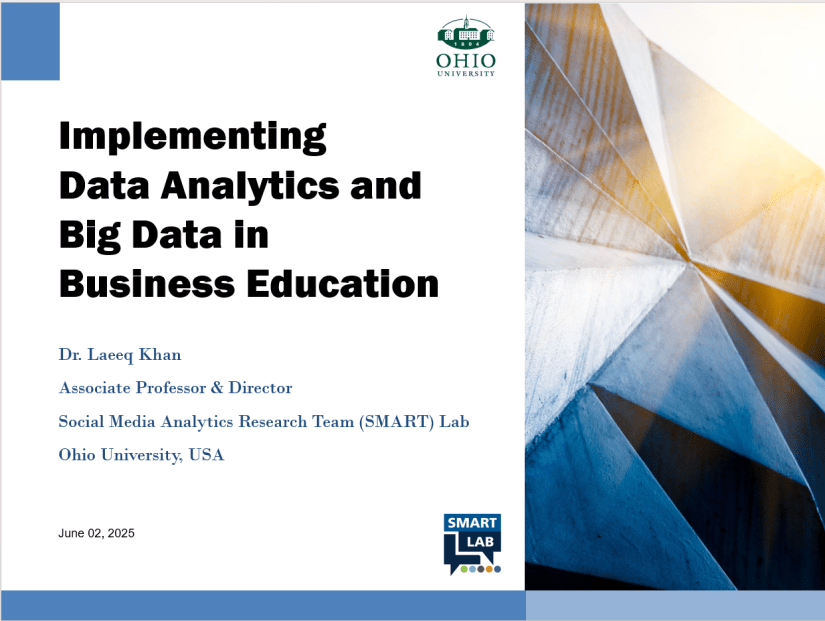
Recently, I had the opportunity to contribute to this transformation by leading a national-level training workshop titled “Implementing Data Analytics and Big Data in Business Education,” organized by the National Business Education Accreditation Council (NBEAC) in Pakistan. The workshop brought together faculty, department chairs, and deans from some of the country’s most respected business schools for an in-depth, hands-on session that explored the future of business education in the data age.
This wasn’t just another training session. It was a continuation of my broader commitment to modernizing education across borders and disciplines. Over the past several years, I’ve had the privilege of:
- Helping design and enhance a communication program at the American University in Ras Al Khaimah (UAE) in alignment with SACSCOC—a leading accrediting body in the U.S.—focusing on curriculum rigor and quality assurance.
- Enriching NUST Business School in Pakistan with data analytics coursework and pedagogical strategies rooted in practical application.
- Offering curriculum and data consulting for a business school in Oman, helping align academic offerings with industry demands and analytics capabilities.
- Leading student training workshops at the University of Ottawa in Canada, focused on integrating communication and data analytics skills into classroom practice.
- Contributing to the Data Science BSc program at Ohio University, where I currently serve as Associate Professor and Director of the SMART Lab, focusing on social media analytics, digital strategy, and experiential learning.

These efforts reflect a unified vision: education must align with the skills and challenges of our time. Whether students are learning marketing, management, or communication, fluency in data analytics and big data must be foundational—not supplementary.
The NBEAC workshop embodied this vision. It offered:
- Practical strategies for curriculum redesign, including how to integrate tools like Tableau, Power BI, and Python into existing courses.
- Case studies that illustrated successful institutional change through analytics-informed pedagogy.
- Insights into how administrators can lead with data, using analytics for strategic decisions beyond the classroom.
What made this experience truly rewarding was the level of engagement and reflection from participants. These were academic leaders who understood the urgency of transformation and were actively seeking frameworks to turn vision into action. The questions were sharp, the dialogue was rich, and the collaborative spirit was unmistakable.
For me, this reaffirmed that consulting and academic leadership go hand-in-hand. It’s not just about delivering expertise—it’s about co-creating solutions with institutions ready to evolve.
As the landscape of business and education continues to shift, I remain committed to supporting institutions around the world in their journey toward data-informed innovation. The tools exist. The urgency is clear. The next step is leadership that’s bold, strategic, and grounded in insight.
If your institution is preparing to take that step—through curriculum modernization, faculty training, or strategic planning—I welcome the opportunity to collaborate.
Transformation is possible. It starts with asking better questions—and knowing where to find the answers.



 Laeeq Khan, Ph.D.
Leave a comment