I’m excited to announce the publication of our latest collaborative research in Information, Communication & Society — a leading journal (Q1 Scopus) exploring the social dimensions of communication technologies.
Our article, titled “Credibility and Influence in Health Messaging: Examining Medical Professionals’ Role on X in Promoting N95 Respirators during COVID-19“, takes a deep dive into how medical professionals leveraged X (formerly Twitter) as health influencers during the pandemic.
Abstract: This study explores the role of health influencers on X (formerly Twitter) in promoting N95 respirators, with a focus on the accuracy and completeness of the information shared. It evaluates the impact of X influencers on public perception and policy regarding N95 masks. Using a tripartite model integrating eWOM, health messaging, and opinion leadership, the research analyzed 251,740 tweets through social network analysis (SNA) and content analysis. A systematic random sample of 21,436 tweets reveals that influencers with +100k followers and verified accounts achieved higher engagement. While health influencers played a significant role in shaping public understanding, gaps in detailed guidance highlight the need for actionable and precise messaging. Positioned at the intersection of public policy and marketing, our study emphasizes influencer collaboration and standardized communication strategies to improve health information dissemination on digital media.
Read the full article here: https://www.tandfonline.com/doi/full/10.1080/1369118X.2025.2504605
What We Explored
As misinformation spread rapidly during the early stages of COVID-19, especially around mask usage, N95 respirators became a flashpoint for public discourse. Our study set out to examine how trusted voices—particularly medical professionals—navigated the digital space to promote reliable health information.
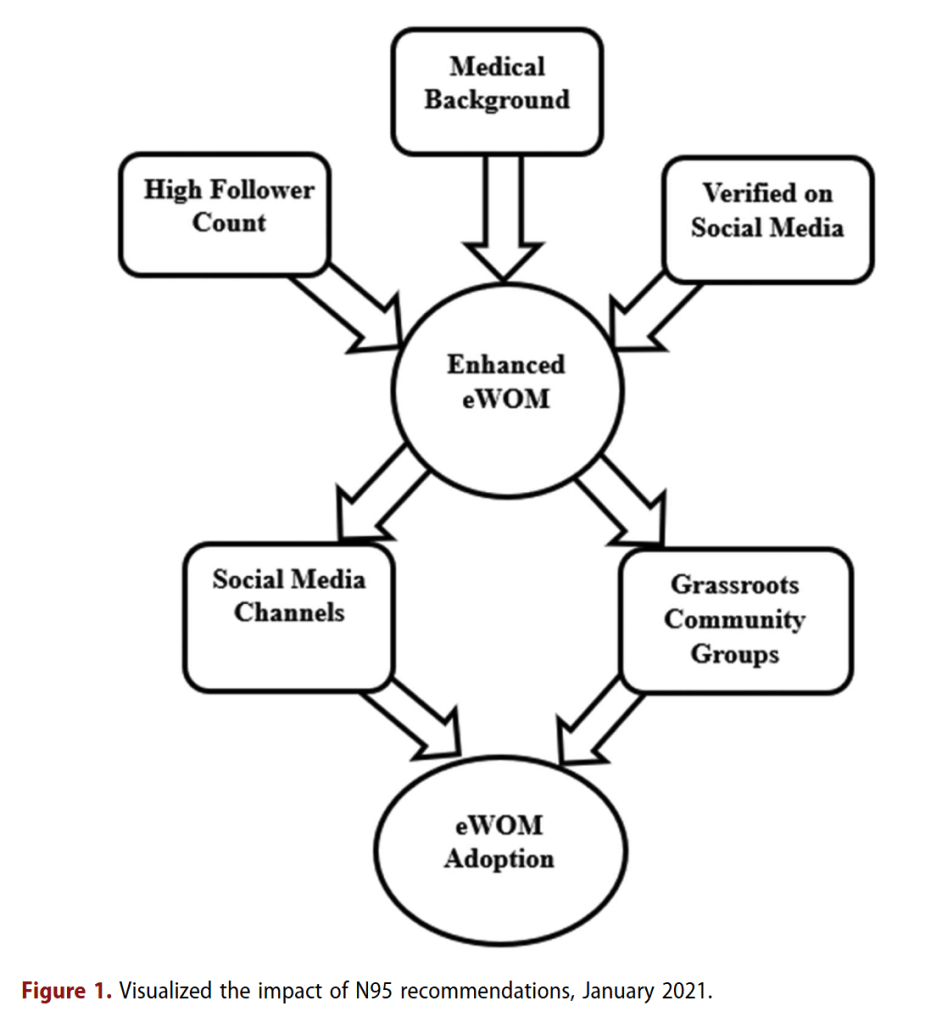
We analyzed over 250,000 tweets using a mixed-methods approach, combining social network analysis with systematic content analysis, guided by a tripartite framework grounded in:
Electronic Word of Mouth (eWOM)
Health Communication Theory
Opinion Leadership
Key Findings
✅ Verified users and those with over 100K followers drove the most engagement.
❗ Even among top influencers, clear, actionable messaging was often missing—highlighting a crucial gap between credibility and communication effectiveness.
🤝 Influencers played a pivotal role in shaping not just public understanding, but also broader policy debates around mask usage.

A Global Collaboration
This project brought together researchers from seven institutions across four continents, including:
University of Hull
Ohio University
Sultan Qaboos University
Indian Institute of Management
Durham University
Tufts University
University of Sharjah
Why This Matters
In a world where digital platforms are central to public health communication, the credibility of messengers matters as much as the message itself. This research underscores the need for standardized, actionable, and accurate messaging—especially during global health crises.
As we look toward the future of health communication, this work contributes to a deeper understanding of digital influence, trust, and impact in an age of information overload.
Let’s continue working toward a digital ecosystem where science speaks louder than noise.
HealthCommunication #SocialMediaAnalytics #COVID19 #N95 #DigitalHealth #eWOM #AcademicResearch #InfluencerEffect



 Laeeq Khan, Ph.D.
Leave a comment